
The salty breeze filled Eli’s lungs as his sloop cut through the emerald swells toward a distant outpost. It was a damp Tuesday in 2026, and somewhere between adjusting his tricorn hat and feeding a cracker to his parrot, Dooley, he realized this wasn’t just a game—it was a living, breathing ocean that had swallowed millions of souls into its shared world. When Sea of Thieves first hoisted its sails back in 2018, few predicted this cartoon-pirate sandbox would snowball into one of the most enduring multiplayer phenomena of the decade. Yet here she was, eight years old and still crackling with the chaos of emergent voyages, cannon fire, and spontaneous shanties.
Like barnacles on a ship’s hull, the player base stuck fast and multiplied. Back in 2020, analyst buzz revealed a staggering 11 million pirates had already crossed the gangplank, with the game surging on a global wave of lockdown camaraderie. By 2026, that number had ballooned well beyond what any treasure map could chart. Rare’s experiment in open-sea mischief had become a quiet giant—splitting its audience almost evenly between console deckhands and PC buccaneers, and finding its richest plunder in markets like Korea and China, where crews organized with near-military precision.
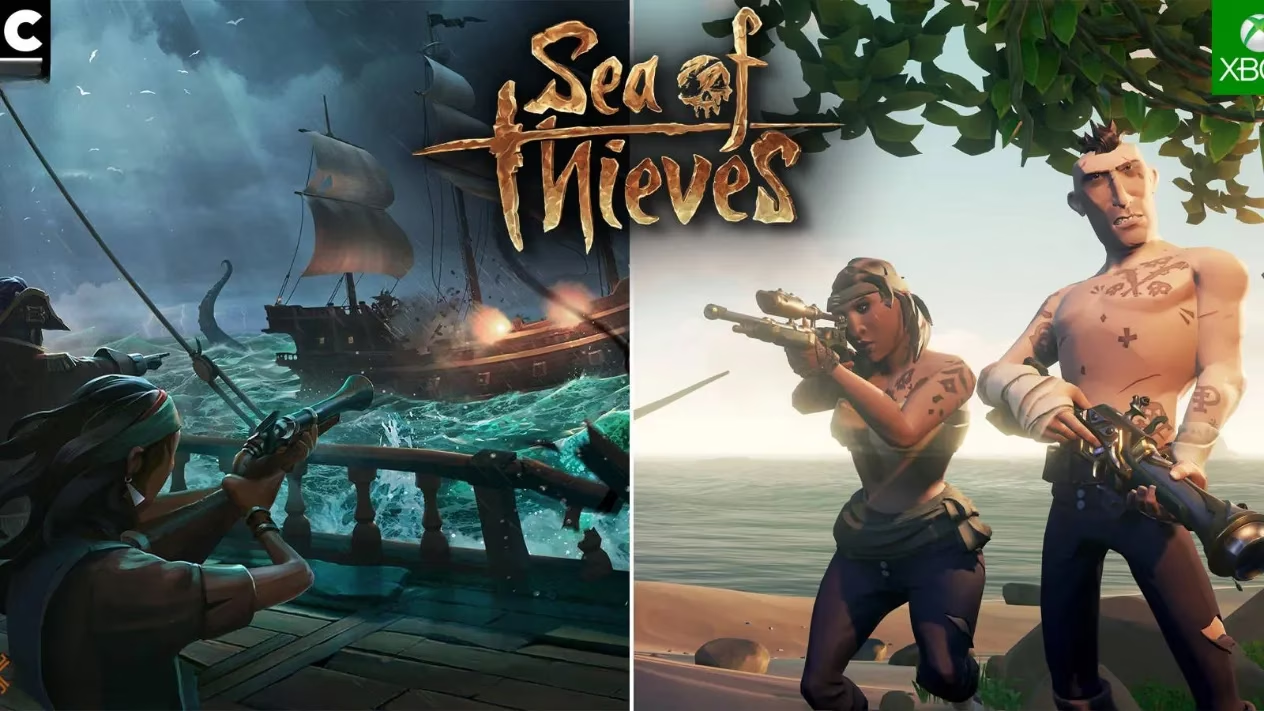
Eli had heard the old complaints from launch year: a sea so wide but so shallow, repetitive fetch-quests that felt like polishing the same doubloon a hundred times. But the Sea of Thieves of 2026 was a different beast. It had grown organically, like a coral reef accumulating nooks and crannies over seasons of free updates. New story-driven Tall Tales wove narrative threads through sunken temples and volcanic fortresses. World events erupted with terrifying frequency—skeleton fleets clashing under blood-red skies, megalodons breaching the waves like a heart attack of teeth and rage. Every session was a roll of the dice, and even a lone sailor on a sloop could tangle with a galleon crew and emerge with a hold full of stolen loot or a glorious watery grave.
That unpredictability was the game’s secret current. The shared-world design meant every sail on the horizon was a question mark—friend, foe, or someone equally lost and willing to form an impromptu alliance. In 2020, the pandemic had poured gasoline on this social bonfire, but even years later, the fire never went out. With cross-platform play bridging every device, a pirate on Xbox Series Z could clink grog mugs with a Steam Deck wanderer without a hitch. The community had become a sprawling, multilingual flotilla bound by emotes, fireworks, and the universal language of betrayal with a smile.
Of course, life at sea became infinitely more charming when the pets padded aboard. Since August 2020, reluctant corsairs could adopt cats, dogs, monkeys, and parrots—all rendered with a comical fluffiness that belied their usefulness in spotting incoming boarders. In 2026, Rare had expanded the menagerie to include pet ferrets that scurried through cannon ports and capuchins that stole bananas from enemy supply barrels. For many, like Eli, the creatures weren’t just cosmetics; they were mascots of shared memories, silent witnesses to sinkings and triumphs alike.
Visually, the game had aged like a bottle of fine rum. The jump to 4K, 60 frames per second on the Xbox Series X gave every sunset a painterly glow, while PC players pushed the draw distances until entire archipelagos shimmered on the horizon. The art style—those winsome pastel hues and bobbing, puppet-like animation—had proven timeless, sidestepping the gritty realism that dated so many other seafaring titles. It was as if the world of Sea of Thieves was a watercolor painting that never dried, constantly refreshed by the collective imagination of its players.
Eli glanced at his watch—a real-world one, for once—and realized he’d been sailing for four hours. Dooley squawked and pointed a wing toward a sloop on the horizon. New friends, or new enemies? It didn’t matter. Like every pirate who had ever hoisted the black flag, he knew the real treasure was the story that would unfold next. And in 2026, Sea of Thieves had a million more tales to tell.
In the grand ledger of Xbox Studio’s greatest hits, few projects had earned their keep so thoroughly. It had started as a risky, content-light party game—a bottle of rum that not everyone could stomach. But Rare had weathered the squalls, listening, expanding, and never losing the childlike wonder of being a pirate. With its eleventh year on the horizon, Sea of Thieves had become something rare: a live-service game that felt more like a second home than a checklist. And for the 30 million players who now called it their digital sea, that was all the treasure they needed.