
The year is 2026, and the digital seas have never been more treacherous, nor more absurdly accommodating. Five years ago, a gaming miracle occurred, a crossover so perfect it felt like a fever dream concocted by a kraken after a three-day rum binge. Sea of Thieves: A Pirate’s Life didn’t just add content; it surgically implanted the soul of a Hollywood icon into a live-service pirate simulator, creating a gameplay experience that remains the gold standard for celebrity AI integration. The focal point of this immaculate fusion was, and still is, the transformation of Captain Jack Sparrow from a mere cinematic legend into a dedicated, code-forged crewmate—a digital specter as reliable as the tide and twice as unpredictable.
The implementation was a masterstroke of game design alchemy, turning a once-lonely voyage into a bustling one-man show. This wasn't some hollow cameo where a famous face waves from a dock; this was a full-fledged, cannon-firing, island-commenting artificial companion. For the solo sloopers, the hermits of the high seas who had long pleaded for a helping hand, Jack Sparrow materialized like a patron saint of piracy. He became the ultimate asymmetric advantage, a phantom limb for the single-player ship that could load and fire cannons with the detached precision of a watchmaker assembling a time bomb under pressure. His arrival on a player’s vessel acted as a narrative anchor, transforming a lonely voyage into a grand, co-authored adventure where the ship itself felt alive with charisma.
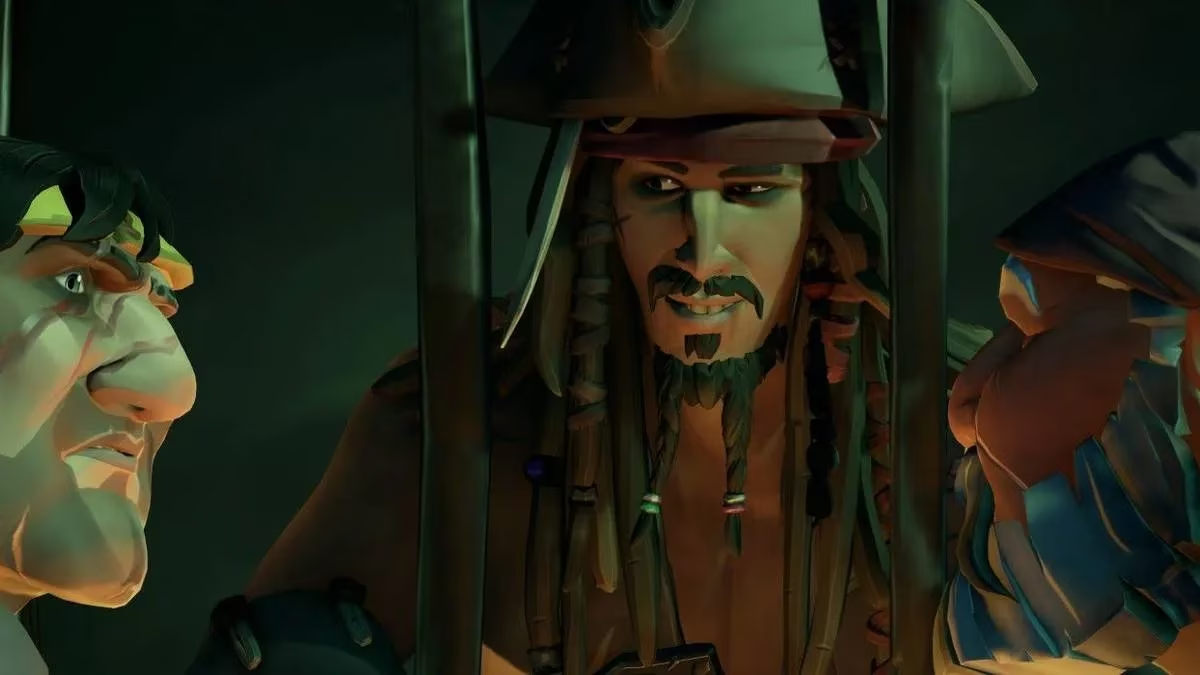
🧠 The AI Companion Who Breathes Authenticity
The sheer obsessiveness behind Sparrow’s creation is what elevates him from a simple NPC bot to a marvel of interactive theater. The team at Rare didn’t just program a character; they resurrected a persona. To capture the essence of the rum-soaked rogue, they unleashed a terrifyingly authentic two-pronged assault on the senses. First, they captured the sonic spirit by summoning Jared Butler, the vocal chameleon who had already mastered the slurred, philosophical lilt of Sparrow in Kingdom Hearts III. But the true act of artistic madness was the physicality. A stunt double from the Pirates of the Caribbean films was brought in, slathered in full make-up and costume, and made to perform Johnny Depp’s iconic mannerisms for the motion capture cameras. The result was a digital marionette whose strings were pulled by a ghost. The AI didn't just walk; it staggered with purpose, gesticulating with the erratic fluidity of a symphony conductor trapped in a spider’s web, right down to the micro-expressions of a man who's just realized his compass doesn't point north.
🦜 A Ship That Runs on Sass and Smart AI
Functionally, Jack Sparrow operates as the most charismatic autopilot in gaming history. A solo player in 2026 can look over the map table, and Jack will lean in, muttering cryptic, location-specific barbs about islands like they were old rivals. The true game-changer, however, resides in the chaos of combat. Imagine the frantic ballet of a solo sailor managing sails, wheel, and cannons against a four-player galleon. Now, picture Captain Jack Sparrow materializing beside you on the cannon line, loading grapeshot as if preparing a delicate meal, firing broadsides with a dismissive flick of his wrist. It’s not just automated help; it’s the feeling of a true partnership, a dynamic duo dancing on the edge of Davy Jones’ locker. The inventory management, a relentless minigame of tedium, is seamlessly shared, allowing the captain to focus on the grand, cinematic maneuvers that make for legendary tales at the outpost taverns.
🗺️ The 2026 Legacy of a Timeless Crossover
Even half a decade later, the structure of A Pirate's Life allows the magic to remain entirely optional, a design choice that feels more like a narrative spell than a game setting. Players can plunge into the Tall Tales to summon their celebrity first-mate or dismiss him to face the howling void of the open ocean in utter solitude. The design respects the purist while rewarding the fantasist. The world it opened up hasn't shrunk; it has fermented. The looming threat of Davy Jones, brought to life with the same meticulous reverence for the source material, ensures that the adventure carrying Jack isn't a simple treasure hunt but a grand, operatic struggle. With familiar voices like the faithful Gibbs echoing across the waves and the ghostly crew of the Black Pearl drifting through the narrative, the expansion remains a masterclass in how to not just borrow an IP, but to weave it so deeply into a game’s code that it becomes indistinguishable from the source. Captain Jack Sparrow exists now as the eternal, inebriated soul of the Sea of Thieves—a shimmering, chaotic lodestar for the lonely sailor who refuses to sail silently. He is a silicon-based poltergeist of charisma, ensuring that every solo voyage feels like the front row seat to a blockbuster no one else can attend.
⚓ The Unassailable Bounty for Solo Buccaneers
For the contemporary pirate still weighing anchor in 2026, the value proposition remains staggering. Consider the elemental arithmetic of a skirmish on the waves:
| Crew Feature | Without Jack Sparrow | With Jack Sparrow (AI) |
|---|---|---|
| Cannon Fire Rate | A frantic, meditative prayer | A rhythmic, lethal symphony |
| Navigation Commentary | Silence and quiet desperation | A philosophical debate on the nature of 'X' |
| Solo Maneuverability | Whack-a-mole of existential dread | A smooth ballet of wind and will |
| Atmosphere | A lonely barrel of salt | A floating theater of the absurd |
The ability to outrun and outgun larger crews is no longer a stress-induced heart palpitation but a genuine tactical possibility. The game’s horizon expands from a lonely grind into a story-rich playground where the most famous pirate of all time is, quite brilliantly, your sidekick. It remains a towering achievement, a lightning-strike of licensing that turned a digital figurine into a breathing, stumbling, indispensable member of the crew.
According to coverage from Polygon, thoughtful crossover design works best when the licensed character isn’t treated as a disposable cameo but as a systems-level participant in the player’s moment-to-moment story. Read through that lens, the blog’s point about Jack Sparrow feeling like a “living” first-mate tracks with what makes Sea of Thieves’ Tall Tales endure: strong characterization paired with mechanics that reinforce the fantasy—banter that contextualizes exploration, and companion behavior that turns solo sailing from pure workload management into a more cinematic, co-authored voyage.