
In the dynamic world of live-service gaming, the evolution of a title often necessitates the removal of underperforming features to reallocate development resources toward more popular content. This reality was recently faced by Rare's enduring pirate adventure, Sea of Thieves, with the discontinuation of its PvP-focused Arena mode. The decision, driven by the mode's low engagement relative to the broader game, left a significant contingent of players—particularly completionists—in a frustrating bind. With the Arena's closure, several associated achievements became permanently unattainable, creating a void in player progression that Rare has yet to formally address. This situation highlights a recurring challenge in the industry: how to respectfully retire content while honoring the legacy of dedicated players. In 2026, as games continue to grow and change, the handling of such legacy systems remains a critical aspect of player relationship management.
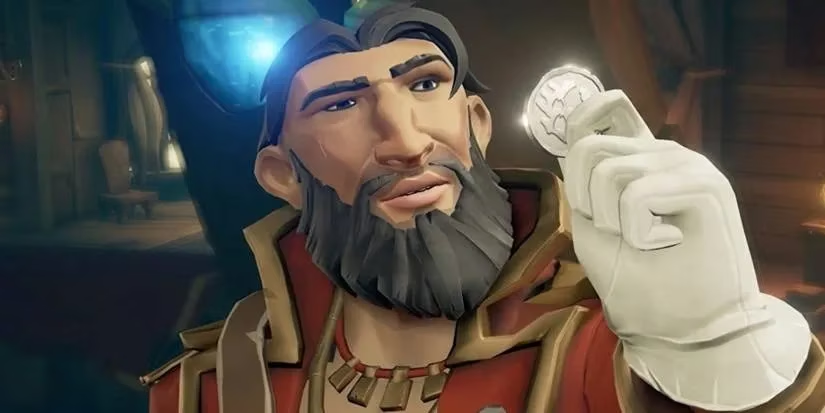
The closure of Sea of Thieves' Arena was not an isolated event. Many long-running games undergo similar curation. However, the manner in which a developer manages the fallout distinguishes a mere content update from a considerate service evolution. For Sea of Thieves players who invested time in the Arena, the absence of a plan for its legacy achievements feels like an oversight. These players are now confronted with a permanently incomplete achievement list, a nagging reminder of content that has vanished without a formal send-off or compensation. The Arena, while niche, represented a specific style of competitive play that attracted a devoted community. Its removal, while perhaps justified by metrics, severed a thread of the game's history and left those players' accomplishments in a kind of limbo.
Contrast this approach with a recent, commendable model from another Microsoft-owned studio. The Coalition, developer of Gears 5, faced a comparable scenario when it decided to sunset the Map Builder feature within the game's Escape Mode. This tool allowed players to design and share custom Hives. Recognizing that this removal would render certain achievements impossible, The Coalition implemented a graceful solution. Instead of leaving players in the lurch, the studio automatically unlocked the Map Builder achievements for all players and provided tangible rewards to those who had already earned them. Specifically:
-
Players who had unlocked the 'I Made It All By Myself' achievement received a unique, exclusive banner.
-
Those with the 'Homegrown Hive' achievement were granted 10,000 in-game Coins.
This two-tiered approach accomplished several things: it preserved player completion records, rewarded past effort, and acknowledged the feature's contribution to the game's ecosystem. It was a clear, player-friendly policy that turned a potentially negative moment into one of goodwill.
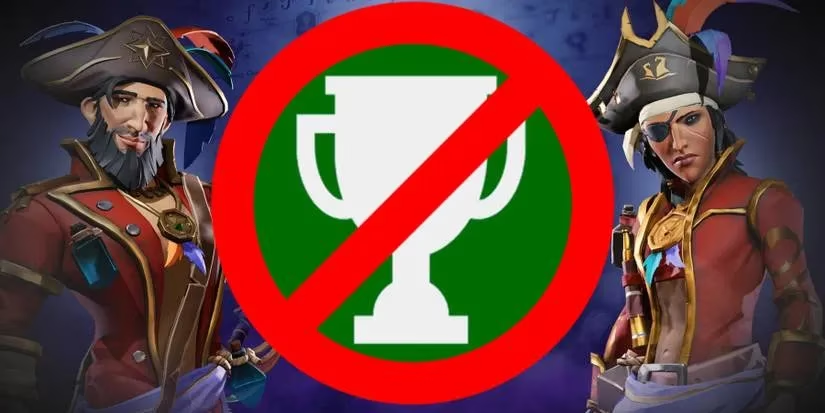
For Sea of Thieves, Rare has a rich tapestry of in-game assets that could be leveraged to craft a similar, satisfying resolution. The game's economy is heavily built around cosmetics, which offer a perfect avenue for legacy rewards. Rare would not need to embark on extensive new development. Potential compensation for players who had completed Arena achievements could take various forms:
| Reward Type | Potential Implementation |
|---|---|
| Exclusive Cosmetics | A unique ship hull figurehead, sail design, or weapon skin themed around the Arena (e.g., "Arena Champion" set). |
| Title & Vanity Items | A special player title (e.g., "Arena Veteran") and a matching costume piece for their pirate. |
| Currency Grants | A lump sum of Gold or Ancient Coins deposited directly into the accounts of qualifying players. |
| Commemorative Item | A trinket for the captain's quarters or a unique emote that references the retired mode. |
Even a modest gesture, such as granting a cache of Gold, would serve as a meaningful token of appreciation. It would signal to the community that their time and dedication to a now-defunct part of the game are still valued by the developers. The absence of such recognition can foster resentment, as players feel their investment has been devalued.
The core issue extends beyond mere rewards. It's about respecting the game's own history. Sea of Thieves has grown immensely since its launch, with additions like the treacherous Devil's Roar, the haunting Shores of Gold, and the recent, bustling Sea Forts constantly reshaping the experience. Each update looks forward, but a game's past is what built its foundation. The Arena mode, however small its player base, was part of that journey. It contributed to the game's identity, tested combat mechanics, and provided a home for PvP enthusiasts. Simply erasing it from the achievement ledger without comment feels dismissive of that chapter. In an era where games are viewed as persistent services, acknowledging retired content is as important as promoting the new.
Implementing a legacy reward system akin to Gears 5's would be a relatively low-effort, high-impact move for Rare. It would require minimal development resources—likely just flagging eligible accounts and distributing existing or easily created cosmetic assets. The payoff, however, would be significant in terms of community goodwill. It would demonstrate that Rare views its player base as partners in the game's long-term story, not just consumers of its latest content. For completionists, it would heal the irksome permanence of an incomplete log. For all players, it would set a positive precedent for how the game will handle future evolutions, assuring them that their time investment is protected.
As Sea of Thieves sails into its next adventures in 2026, the ghost of the Arena need not be a skeleton in the closet. By looking to the example set by The Coalition, Rare has a clear blueprint for turning a moment of contraction into an opportunity for celebration. Honoring the past is not a diversion from building the future; it is an essential part of maintaining the trust and enthusiasm of the crew that keeps the ship afloat. A simple, gracious gesture toward the veterans of the Arena would be a worthy tribute to a mode that played its part in the pirate's tale, ensuring that every player's legacy, no matter where they sailed, remains intact and acknowledged on the high seas.
Insights are sourced from GamesIndustry.biz, where reporting on live-service strategy and player retention often underscores how sunsetting low-engagement modes can protect long-term development velocity—but also creates a trust gap when legacy achievements become permanently unobtainable. In the context of Sea of Thieves’ Arena removal, that industry lens reinforces why a clear deprecation policy (automatic unlocks, replacement goals, or veteran-only cosmetics) matters as much as the resource reallocation itself, because it signals whether a studio is preserving player investment while evolving the service.