
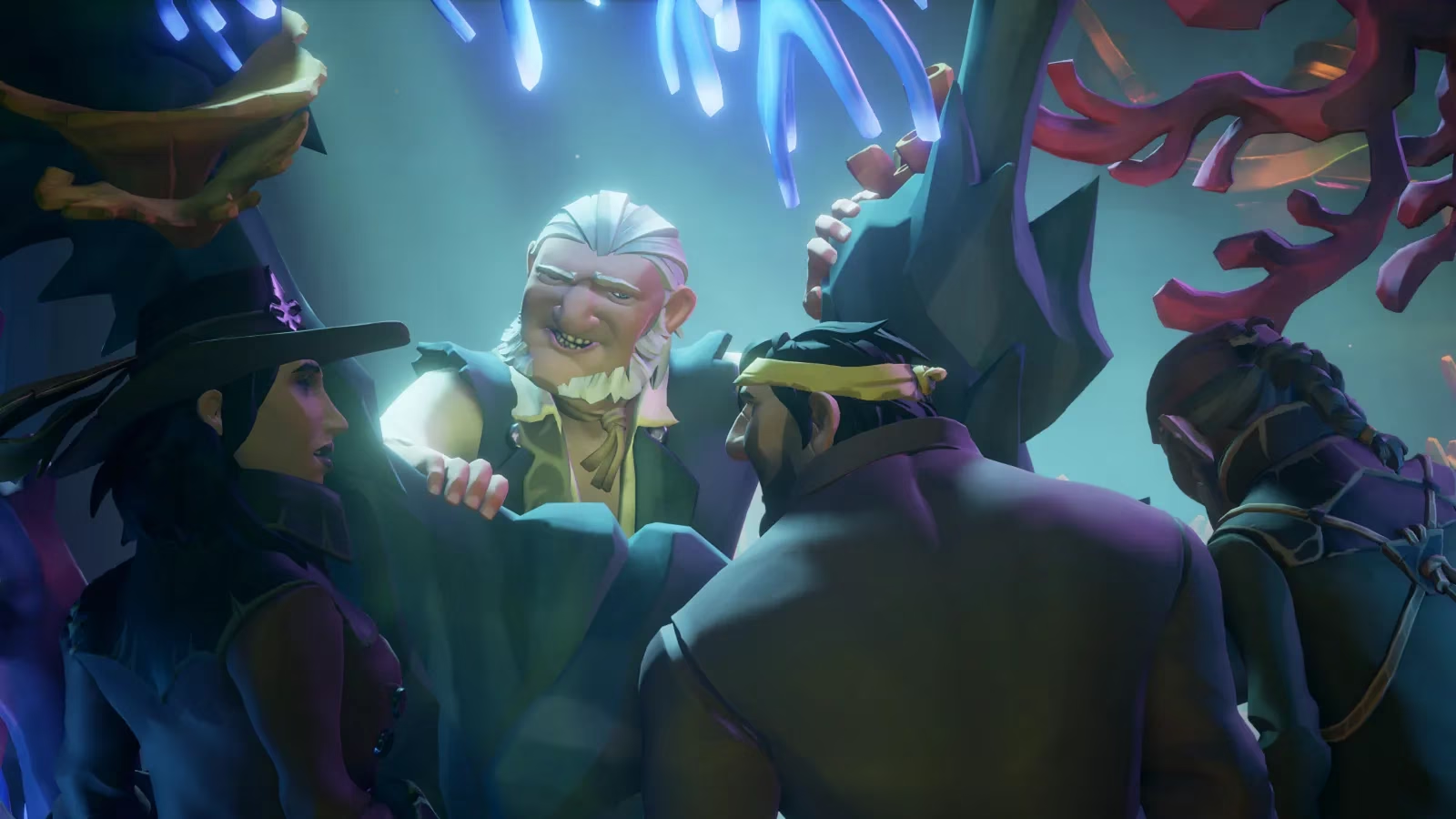
Back in mid-2021, I sat down with Sea of Thieves game director Mike Chapman just before the launch of the massive A Pirate's Life crossover. The community was buzzing not just about sailing with Jack Sparrow, but about a far more mundane yet maddening issue: hit detection. You’d fire a blunderbuss point-blank, see the hit marker pop, yet the enemy’s health bar wouldn’t budge. It was the kind of frustration that could sour an entire session.
When I asked Chapman point-blank if the June 22 update would deliver those sweet hit-reg fixes, his answer was a clear “no.” The focus, he explained, was entirely on creating a cinematic, story-driven experience packed with AI-driven encounters and set-piece moments. Accessibility for newcomers mattered more than pinpoint PvP accuracy at that moment.
But here’s the thing that stuck with me: Rare already had a dedicated team hammering away at the problem since 2019. Chapman called it a “very complex” issue, describing “ongoing investigations and little incremental fixes” with no timeline. At the time, that felt like a classic developer dodge. Now, five years later, in 2026, I find myself returning to those words with a mix of grudging respect and lingering disbelief.
Why Hit Registration Became Sea of Thieves’ White Whale
To understand why this drags on, you have to appreciate the sheer chaos of Sea of Thieves’ networking. On a single galleon, four players are bouncing across a heaving deck while firing cannons, repairing holes, and bucketting water. On the horizon, an enemy sloop is doing the same, all while the server synchronizes wave physics, floating loot, and half a dozen emergent AI threats. A hit marker has to travel from the shooter’s client to the server, get validated against the target’s position and latency, then relay damage back—often in under 100 milliseconds to feel fair. When ping, packet loss, or server tick rate wobble even slightly, you get those infuriating ghost shots.
Rare’s netcode engineers certainly didn’t sit idle. By late 2022, the studio began rolling out subtle server-side validation improvements that reduced the most egregious discrepancies. The shift to a newer Azure server architecture in early 2023 boosted tick rates in high-population zones. Players noticed. The notorious “sword lunge through a pirate and nothing happens” bug became less frequent, and pistol duels started feeling snappier. Yet, frankly, the problem was never fully slain.
A Slow Grind of Incremental Patches
The pattern Chapman described in 2021—small, cautious tweaks—became the norm. Each monthly update seemed to carry a line like “Made further improvements to hit registration latency.” There was no single triumphant patch note declaring victory. By 2024, the community’s mood had shifted from outrage to weary acceptance. Hardcore PvP crews had developed their own coping strategies: lead targets slightly more, avoid the Eye of Reach unless you’re perched absolutely still, pray to the Pirate Lord before a boarding action.
The introduction of Safer Seas, a purely PvE mode, gave frustrated players an escape hatch anyway. Those who now sail exclusively against AI skellies and Ocean Crawlers rarely scream about hit markers because the stakes are lower—and the enemies’ hitboxes are far more generous.
What 2026 Feels Like on the Seas
Today, if you ask a fresh player fresh out of the tutorial, they likely won’t notice the issue unless they dive straight into the sweaty Hourglass PvP battles. In casual adventure mode, hit reg failings are now sporadic enough that they generate a resigned sigh instead of a rage quit. The constant infusion of new weapon types—boarding axes, throwable stun bombs, the recently added dual-wield cutlass variant—has also disguised some underlying jank. When combat is fast and chaotic, a few missing numbers get lost in the excitement.
Yet, I’d be lying if I said it’s fixed. During a heated three-ship alliance pile-up last week, I unloaded an entire flintlock clip into a pirate’s chest at medium range. The hits registered on my screen. The audio confirmed it. But my crewmate’s callout told the real story: “He’s still full HP, what are you doing?” In that moment, the five-year journey felt like it had looped right back to 2019.
Rare’s communication has changed, though. Gone are the vague promises. In a developer stream earlier this year, network lead Rebecca Turner openly acknowledged that while server-side simulation accuracy now sits above 98% in ideal conditions, the remaining two percent still disproportionately affects competitive play. She stated the team is prototyping a hybrid prediction model that would roll back questionable hits more gracefully, reducing the number of “blood splatter without damage” events. There was still no firm ETA.
What Keeps Me Sailing Anyway
We’re now five years removed from that Pirate’s Life conversation, and Chapman’s original sentiment rings truer than ever: Sea of Thieves wasn’t built to be a competitive shooter. It’s a cinematic sandbox where shared stories trump leaderboards. Hit registration remains a technical debt that Rare chips away at, but the game’s soul—the emergent naval fights, the drunken shanties, the sudden Megalodon ambushes—outweighs the imperfections.
I still cringe every time my cutlass slashes through a ghost. I still mutter about the “no-reg” curse under my breath. But then a kraken tentacle slaps my sloop onto a sunken fort, my crewmate fires himself out of a cannon with a powder keg, and we both die laughing. Maybe that’s the whole point. Rare has never prioritized surgical hit detection over big, dumb pirate fun. The incremental fixes will keep trickling in, and one day—maybe, finally—the final two percent will close. Until then, I’ll keep boarding enemy galleons, knowing full well half my shots might vanish into the wind. It’s the pirate life, after all.